

Modern military asset design requires a precise balance: maximising blast survivability while minimising vehicle weight for rapid deployment. Off-the-shelf structural steel cannot withstand the severe mechanical and ballistic loads demanded by today’s combat and security environments.
With a two-decade track record in the defence sector, Brown McFarlane acts as the technical bridge between metallurgical capability and military specification. We provide naval shipbuilders, military engineers, and ballistic specialists with mission-critical, fully traceable steel plate. Whether supplying ultra-high-yield steel or precision-profiled armour plate, our materials guarantee integrity. Crucially, every plate we process is supported by complete melt-to-part certification..
Brown McFarlane is also fully accredited by JOSCAR (the Joint Supply Chain Accreditation Register), the industry-recognised standard managed by Hellios. This accreditation validates our commitment to the highest levels of compliance, quality, and security required by the aerospace, defence, and security sectors.
What qualifies as military-grade steel?
Military-grade steel refers to materials manufactured and tested to meet specific defence standards (such as Def Stan, MIL-SPEC, or NATO STANAG) for ballistic performance, chemical composition, and mechanical properties. Key requirements include a certified, consistent Brinell hardness (e.g., 380–500 HBW) to defeat fragmentation, and rigorous impact toughness to maintain ductility in extreme conditions. Crucially, every plate must have documented melt-to-part traceability, such as an EN 10204 Type 3.1 or 3.2 certificate.
Commercial High-Yield vs. Military-Grade Armour: What is the difference?
The primary difference is the balance between ballistic integrity and structural workability. Harder military-grade armour plate is designed to stop or deflect bullets, but its hardness makes it more difficult to weld and susceptible to losing toughness at sub-zero temperatures. Commercial high-yield steel (like S690QL) is softer, welds easily, and resists structural fatigue, but offers limited ballistic protection. To solve this, engineers often specify a composite design: armour plate for highly stressed strike zones and high-yield steel for the load-bearing chassis.
Which steel grades are specified for the defence sector?
Defence applications typically specify three main categories of steel:
- Armour Plate: Grades like Millux 400 to 500 for blast and ballistic protection.
- Quenched and Tempered Steel: Grades such as S690QL and S890QL for high-strength load-bearing structures like launch systems.
- High-Yield Steels: High yield cold forming steel plate offers both strength and formability, with excellent surface quality, dimensional and geometrical accuracy.
- Structural Grades: Such as EN10025 S355 J2+N for foundational infrastructure.
How do you fabricate armour plate without compromising its ballistic integrity?
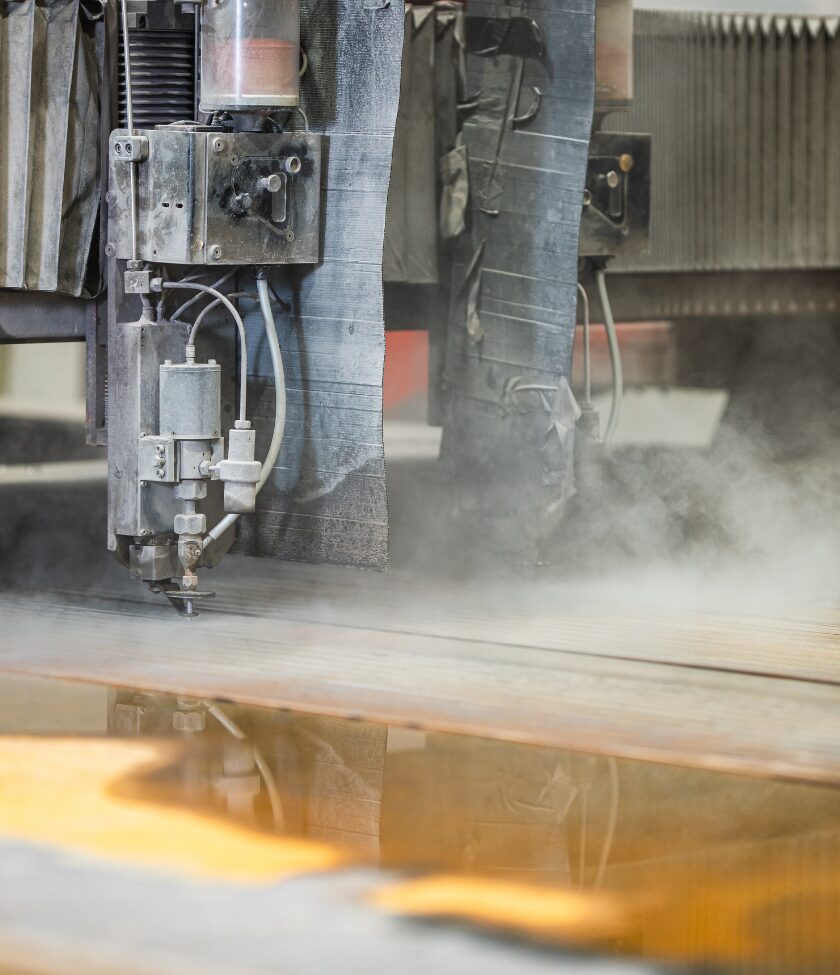
Armour plate requires specialised processing to prevent heat-affected zone (HAZ) vulnerabilities that could compromise ballistic resistance. At Brown McFarlane, we utilise high-definition plasma and waterjet cutting. This allows for precision-bevelled components that are profiled and ready for assembly, reducing the risk of structural failure during final fabrication.
What is the difference between Abrasion Resistant (AR) steel and Armour Plate?
While both offer extreme hardness, they are engineered for different purposes. Abrasion Resistant steel (such as QUARD 400-500) is designed to withstand sliding wear and impact in quarrying or mining environments. Armour Plate (such as the Millux Protection range) undergoes rigorous ballistic testing to certify its ability to absorb and shatter projectiles. AR steel should never be substituted for certified armour plate in life-critical defence applications, though it is often used for mine-clearing ploughs.
How does Charpy V-Notch testing apply to defence steel?
Charpy V-Notch testing measures a material’s impact toughness and its ability to absorb energy before fracturing. In the defence sector, military vehicles and naval vessels operate in extreme environments. High-yield steels like S690QL and S890QL are routinely tested at sub-zero temperatures (e.g., -40°C or -60°C) to ensure the steel remains ductile and does not suffer brittle fracture under sudden blast or impact loading.
Can high-hardness armour plate be cold-formed?
Yes, but forming military-grade armour requires specialist processing capabilities. Due to the high yield strength and hardness of grades like Millux 500, cold-forming requires immense press brake tonnage, strictly controlled minimum bending radii, and correct die widths to prevent surface cracking. Brown McFarlane operates high-capacity press braking equipment specifically calibrated for these extreme tolerances.
Why is water jet cutting recommended for ballistic steel?
Water jet cutting is a cold-cutting process that introduces absolutely no Heat Affected Zone (HAZ) to the steel. When profiling armour plate, traditional thermal cutting can alter the microstructure of the cut edge, potentially reducing its local ballistic resistance. Water jet profiling ensures the original mechanical properties and certified hardness of the plate are maintained directly up to the cut edge, which is vital for modular armour panels.
What is ASTM A578 ultrasonic testing, and why do defence contractors request it?
ASTM A578 is a standard specification for straight-beam ultrasonic examination of rolled steel plates. Defence contractors request this supplementary testing to detect internal discontinuities, such as inclusions or delamination, that cannot be seen on the surface. Guaranteeing internal structural integrity is critical for plates used in submarine pressure hulls or heavy armoured vehicle floors subjected to mine blasts.
| Steel Category | Grade / Range | Key Characteristics | Primary Defence Applications |
|---|---|---|---|
| Armour Plate | Millux Protection (380, 400, 450, 500 HBW) | High Brinell hardness, ballistic and blast protection. | Armoured vehicle hulls, rifle range targets, highly stressed strike zones. |
| High-Yield Steel | S690QL, S890QL | Ultra-high yield strength, low-temperature ductility, weight reduction. | Launch systems, bridge layers, primary load-bearing structures. |
| Structural | EN10025 S355 J2+N | Reliable foundation strength, excellent weldability. | Non-ballistic defence infrastructure. |
| Wear Plate | QUARD (400, 450, 500) | Abrasion resistance | Mine-clearing equipment (plough blades). |
Related News
Navigating Nuclear Compliance: Material Traceability & EN 1090 EXC4 for SMRs